VoIP Line for Alarm System
Yes, your alarm panel can work over a VoIP line. Replace the landline dedicated to your alarm with a line at $6.99 USD/month (about $10 CAD/month): we ship the adapter already configured — all you have to do is plug it in.
How your alarm connects
-
1
Your Internet router
The connection you already have at home
-
2
Preconfigured ATA adapter
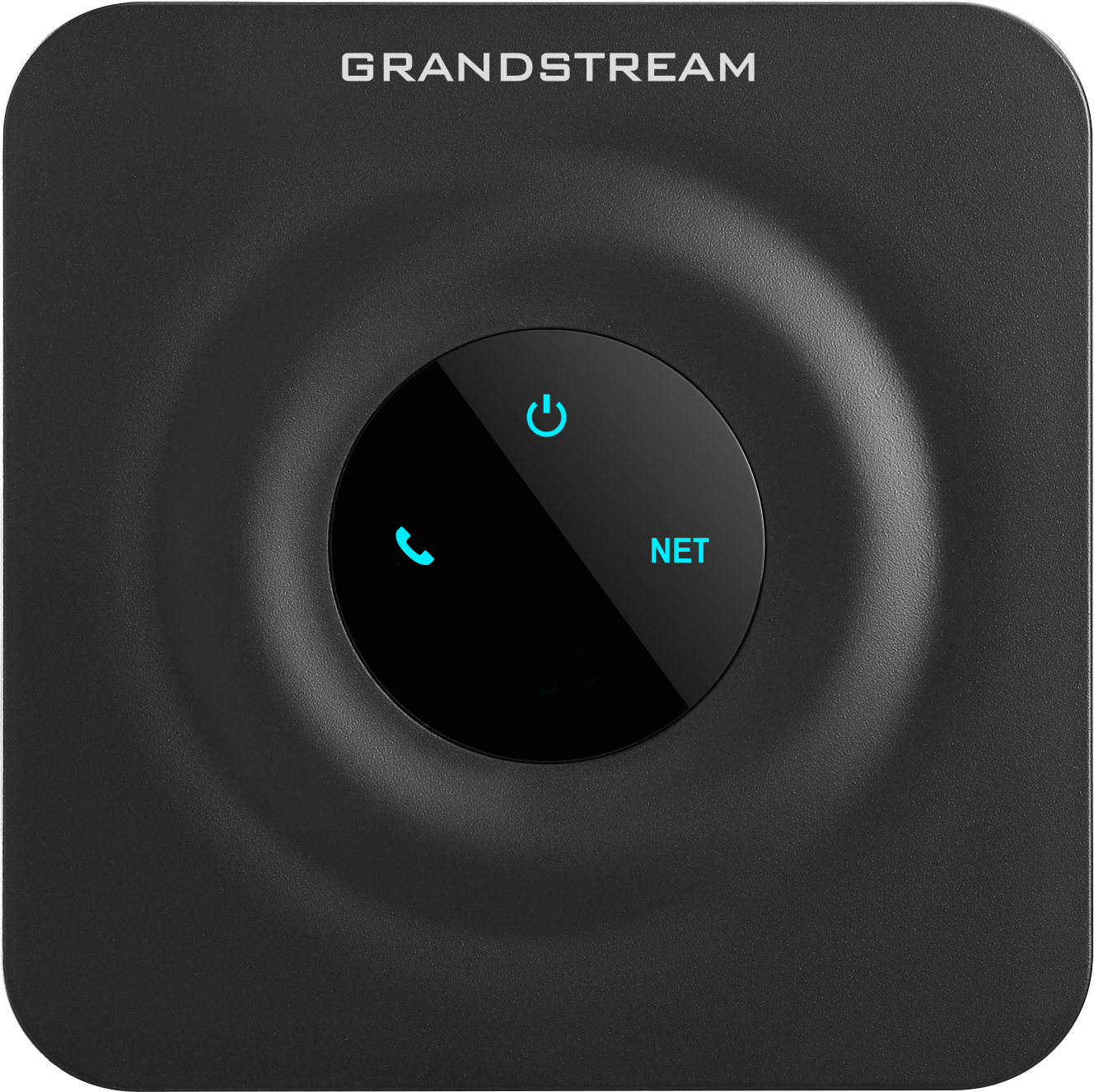
Grandstream HT801v2, shipped alarm-ready
-
3
Your alarm panel
It dials and reports to the monitoring station, just like before
On this page
How an alarm panel uses the phone line
When an event occurs (break-in, fire, panic), your alarm panel dials your monitoring station's phone number and transmits a coded report as tones, using protocols like Contact ID or SIA. It is exactly the same principle as a voice call — except machines are doing the talking.
On an ordinary VoIP line, those tones can be distorted by audio compression, silence suppression or echo cancellation — and the monitoring station no longer understands the message. That is where the "alarms and VoIP don't mix" reputation comes from.
The fix is well known and simple: carry the audio uncompressed (G.711 codec) and disable the processing that alters the tones. That is precisely the configuration we apply to the ATA adapter before shipping it to you. Your panel dials, transmits and hangs up exactly as it would on a traditional landline.
The alarm vendor's "VoIP compatibility module"? Not needed here.
Most alarm system vendors will offer you an extra module (often cellular, with additional monthly fees) "to make your system VoIP-compatible". With our line, it is not necessary: the preconfigured adapter carries your panel's signals through as-is, with no additional equipment. A cellular module is only useful as a backup during a power or Internet outage — not for compatibility.
How it hooks up, in 3 steps
Plug the adapter into your router
Connect the HT801v2 to your router with the included network cable, then to a power outlet. It registers on your line by itself.
Connect the alarm panel
Run a standard phone cord (RJ11) between the adapter's "Phone" jack and your panel's line input. If your installation goes through an RJ31X jack (line seizure), connect the adapter upstream of it so the alarm keeps priority over the line.
Run a test with the monitoring station
Notify your monitoring station and trigger a test signal. They confirm reception — and just like that, your alarm communicates over VoIP.
The ATA adapter, shipped preconfigured for your alarm
We sell the Grandstream HT801v2 for $36 USD (one-time purchase). Mention when ordering that the line will be used for an alarm system and it arrives at your door already configured — nothing to set up on your end.
Concretely, here is what we preconfigure so your panel's signals get through intact:
- G.711 codec only — uncompressed audio, tones reach the monitoring station intact
- Silence suppression (VAD) disabled — no gaps in the signal
- Echo cancellation disabled — tones are not "corrected" along the way
- In-band DTMF — Contact ID and SIA protocols are carried through as-is
The plan you need: Lite
An alarm panel only calls the monitoring station during an event or a periodic test. The Lite plan at $6.99 USD/month and its 600 minutes cover this use with plenty of room — no need to pay for more.
Lite
1 lineA dedicated line for your alarm system
Included
- No contract
- 1 local number included
- Visual voicemail
- Caller ID
- Unwanted call blocking
- Copy of your voicemail messages by email as mp3
- Call forwarding for extended absences (*272 and *273)
Also want a home phone?
Go for the Standard plan at $9.99 USD/month instead: unlimited Canada & United States calling and 2 simultaneous calls. Then plug a passive phone splitter (RJ11 splitter, a few dollars) into the adapter's phone (FXS) port to connect your alarm panel and your phone on the same line.
Good to know: with a simple splitter, the alarm shares the line with the phone. For the alarm to keep priority over the line even during an ongoing call, the ideal wiring goes through an RJ31X jack (line seizure). It is a passive jack sold for around ten dollars online or at electronics stores, and you can install it yourself if you are comfortable with low-voltage wiring — just put your system in test mode with your monitoring station before opening the panel. Otherwise, your alarm technician can do it in minutes.
Why are our prices in US dollars (USD)?
Our calls travel primarily over interconnections located in the United States, where network capacity is more plentiful, better redundant and considerably cheaper than in Canada. That is exactly what lets us offer a reliable line at this price.
Since our costs are in USD, we bill in the same currency instead of adding a currency-conversion margin to your invoice. It is one of the reasons our residential rates have not changed in 10 years.
For reference only, $6.99 USD is roughly $9.40 to $9.95 CAD depending on the exchange rate at the time of billing.
What to know before ordering
We prefer to be upfront: a VoIP line for your alarm is reliable and much cheaper, but there are a few realities to be aware of.
Power and Internet outages
The service will not work during a power outage or if your Internet connection is interrupted — your panel will not be able to transmit during that time. A backup battery (UPS) on your router and the adapter covers brief outages. For critical monitoring, we recommend keeping or adding a cellular backup module through your alarm company: the VoIP line then becomes the economical primary channel, and cellular takes over during an outage.
Validate with your monitoring station
Before disconnecting your old line, notify your monitoring station and run a transmission test after installation. The station confirms it received the signals — that is the validation that really matters.
Very old panels
Some very old panels, or panels using unusual pulse formats, may need an adjustment to the dialing speed or communication format (a setting handled by your alarm technician). If in doubt, contact us before ordering: we will tell you frankly whether your equipment is a good fit.
Traditional landline vs VoIP line for your alarm
Paying for a full landline just for an alarm panel means paying a lot for a few automated calls per month.
| Feature | Our VoIP line | Traditional landline |
|---|---|---|
| Monthly price | $6.99 USD/month | Typically $30 to $60 CAD/month |
| Contract | ✓ None, month to month | Depends on the provider |
| Installation | ✓ Yourself, in minutes | Technician visit often required |
| Equipment | $36 USD ATA adapter (one-time purchase) | None (existing wiring) |
| Works during power outages | No — UPS or cellular backup module recommended | Yes (copper lines only) |
| Contact ID / SIA compatible | ✓ Preconfigured adapter | Yes |
Traditional landline prices vary by provider, region and current promotions. Always verify on the provider's website.
Frequently asked questions
Will my alarm system work with a VoIP line?
What equipment do I need?
Do I have to configure the adapter myself?
What happens during a power or Internet outage?
Can I keep my current phone number?
Should I notify my monitoring station?
My alarm vendor wants to sell me a "VoIP compatibility" module. Do I need it?
Can I connect a phone and my alarm on the same line?
Ready to cut your alarm's landline?
Lite plan at $6.99 USD/month, preconfigured adapter at $36 USD, no contract. Mention "alarm system" when ordering and hook everything up in minutes.